

Commercial Air Duct Cleaning by The Cleaning Master
Commercial Air Duct Cleaning
When you think about your commercial property, you must probably be focusing on its productivity, customer service, and an efficiently working team. However, most owners often overlook air quality, regulated by the HVAC system. Just like in residential properties, commercial properties must make an effort to maintain indoor air quality to keep employees, customers, and tenants healthy and comfortable. The Cleaning Master’s top-notch commercial air duct cleaning continues to attract property owners across Dallas.
What Does Our Air Duct Cleaning Process Involve?
Dallas is well-known for its welcoming atmosphere and extensive urban settlements. People love living and working here, although the city is sometimes plagued by high pollen counts, airborne allergies, and periodic dust storms. Because both home and commercial buildings with complex HVAC systems are exposed to these outdoor contaminants, duct cleaning must be performed on a more frequent basis. With the hot Texas weather placing a strain on your HVAC system, it is necessary to ensure that you are breathing in clean air with no dust, mold, or bacteria.
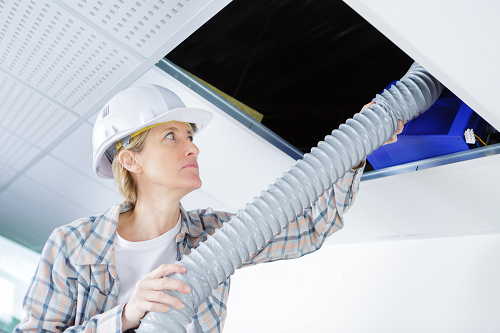
The Cleaning Master’s commercial air duct cleaning involves removing dust, debris, mold, and other contaminants from the ductwork. Air ducts in premises such as offices, homes, stores, warehouses, and schools often collect contaminants over the years. Ignoring this buildup may result in poor air quality within the facility, greater air conditioning expenditures, and health risks for your family, employees, and customers.
Why Does Your Business/Home Need Commercial Air Duct Cleaning by The Cleaning Master?
- Improving Indoor Air Quality
The air within buildings is five times more likely to be contaminated than the air outdoors, particularly in extremely enclosed spaces such as offices and stores. Clean ducts prevent allergens, dust, mildew, and air pollutants from spreading easily and exposing inhabitants to dangerous particles. This is why air quality is especially important in areas like medical institutions, restaurants, schools, and gyms, where visitors are concerned about inhaling hazardous compounds.
- Boosts HVAC’s Efficiency
If the ducts are dusty, airflow might get blocked, causing the HVAC system to work longer than necessary. As a result of the additional effort, energy consumption may increase and equipment may wear out faster. Partnering with The Cleaning Master for professional duct cleaning improves system performance, saves money on energy costs, and extends the life of your HVAC equipment. A business property with high HVAC expenses is inefficient for overall productivity.
- Protect Employee Health, thus Boosts Productivity.
Sick Building Syndrome is a serious condition that occurs when buildings get contaminated, resulting in limited circulation of fresh air. Headaches, weariness, sore eyes, and breathing issues are among the symptoms, which may lead to less work and more sick days. Regular air duct cleaning by The Cleaning Master eliminates contaminants that cause illness, allowing your team/family members to remain healthy and productive.
How Often Should You Have Your Commercial Air Ducts Professionally Cleaned?
Commercial and residential properties should have their ducts cleaned every three to five years. Nonetheless, certain industries may require routine cleaning, such as:
- Properties in locations with high-traffic
- Properties currently undergoing renovations
- Properties close to construction projects
- Industrial buildings.
- Buildings with pets, smokers, and individuals who have allergies
- Hospitals or childcare facilities
If your property falls in the above-mentioned categories, contact The Cleaning Master, and we will help develop an inspection and maintenance plan that is appropriate for your property.
What to Expect from Us
Hiring us for air duct cleaning in Dallas provides you with more than a cleaning service. We also ensure you benefit from relevant maintenance training. Our approaches are supported by:
- High-powered HEPA-filtered vacuum
- Advanced devices to loosen stuck debris
- Mold and microbial treatments, if necessary
- Before-and-after inspections for complete transparency
Our objective is to minimize disruptions by adjusting our work schedules to your specific hours.
Book a Consultation
Get a free estimate and save your money!
Talk to an Expert
Send an Email
Our Service Areas
Our services are available throughout the region, ensuring that quality solutions are always within reach, no matter where you are located.
- Acworth
- Alpharetta
- Berkeley Lake
- Brookhaven
- Buford
- Chamblee
- Cumming
- Decatur
- Doraville
- Druid Hills
- Duluth
- Dunwoody
- Fayetteville
- Flowery Branch
- Gainesville
- Johns Creek
- Kennesaw
- Lawrenceville
- Lilburn
- Mableton
- Marietta
- McDonough
- Milton
- Mountain Park
- Newnan
- Norcross
- Peachtree City
- Roswell
- Sandy Plains
- Sandy Springs
- Snellville
- Smyrna
- South Fulton
- Stone Mountain
- Suwanee
- Tucker
- Vinings
- Woodstock
We Are Ready For 24/7 Emergency Service
Scheduele an appointment today with our experts!
Frequently Asked Questions
Find answers to our most popular questions here
What is commercial air duct cleaning?
How is commercial air duct cleaning different from residential duct cleaning?
Commercial buildings usually have larger and more complex HVAC systems, multiple air-handling units, rooftop equipment, larger duct networks, restricted areas, and different operating schedules. Commercial projects often require site-specific planning, safety coordination, after-hours scheduling, specialized access equipment, and written documentation.
How much does commercial air duct cleaning cost in Dallas, TX?
How is a commercial air duct cleaning estimate calculated?
A contractor may consider the number and size of air-handling units, linear footage of ductwork, number of supply and return openings, equipment access, building use, working hours, containment requirements, and condition of the system. The proposal should define the areas, components, exclusions, cleaning methods, and verification procedures.
How often should commercial air ducts be cleaned?
What are the signs that a commercial HVAC system needs cleaning?
What types of commercial buildings can receive air duct cleaning?
Can commercial duct cleaning be completed after business hours?
Will we need to close the business during duct cleaning?
How long does commercial air duct cleaning take?
What does commercial HVAC-system cleaning include?
The scope may include supply and return ducts, main trunks, registers, grilles, diffusers, fans, air handlers, coils, drain pans, and other accessible components. Not every proposal includes every component. NADCA notes that commercial specifications should be adapted to the individual building and system. NADCA commercial standards
Does cleaning only the ductwork clean the entire commercial HVAC system?
No. Cleaning only the ducts may leave contamination on other HVAC components that can re-enter the air-distribution system. A complete scope should identify which components require cleaning and which are excluded. Building owners should compare proposals based on scope rather than price alone.
What cleaning methods are used for commercial air ducts?
Methods may include negative-pressure collection, HEPA-filtered vacuum equipment, compressed-air tools, mechanical agitation, brushes, whips, and controlled access openings. The selected method should match the duct material and contamination type while protecting lined, flexible, coated, or otherwise sensitive system components.
What is negative-pressure commercial duct cleaning?
Negative pressure places the selected duct section under continuous vacuum during cleaning. Agitation tools loosen debris, which is drawn toward collection equipment rather than released into occupied areas. The system may need to be divided into zones so that each section can be cleaned and controlled effectively.
Will commercial air duct cleaning create dust inside the building?
A properly planned project should use containment, negative pressure, sealed access points, and suitable collection equipment to limit the release of debris. Sensitive areas may require additional isolation and coordination. The contractor should explain the dust-control plan before work begins.
Can commercial duct cleaning improve indoor air quality?
Cleaning can remove contaminants present inside a dirty HVAC system, but indoor air quality is also affected by ventilation, filtration, moisture, outdoor air, occupant activities, cleaning products, and other pollutant sources. Duct cleaning should be part of a broader building assessment rather than presented as a guaranteed solution to every indoor-air complaint.
Can commercial air duct cleaning reduce energy costs?
Cleaning may help when heavy contamination is restricting airflow or affecting coils, fans, or other HVAC components. However, it does not guarantee energy savings. Equipment condition, controls, filtration, duct leakage, maintenance, insulation, and building operation may have a greater effect on energy consumption.
Can commercial duct cleaning remove mold?
Some contamination can be removed from cleanable, nonporous HVAC surfaces, but the moisture source must first be identified and corrected. Wet or contaminated porous insulation may require removal and replacement. Mold-related work may also require additional containment, assessment, and remediation procedures beyond ordinary duct cleaning.
Should commercial air ducts be sanitized after cleaning?
Sanitizing is not automatically necessary for every commercial system. Any chemical product must be appropriate and legally registered for the intended HVAC surface and application. The facility manager should receive the product name, label, safety information, purpose, application method, and reentry requirements before approving treatment.
Does commercial air duct cleaning satisfy OSHA or health-code requirements?
Duct cleaning alone does not automatically establish compliance with OSHA, health-department, building, medical, or industry-specific requirements. Applicable obligations depend on the building and business type. Any required cleaning standard, documentation, safety procedure, or testing criteria should be included in the project specifications.
Is commercial air duct cleaning the same as restaurant hood cleaning?
No. HVAC duct cleaning addresses the building’s heating, cooling, and ventilation system. Commercial kitchen exhaust cleaning addresses grease-laden hood, duct, and exhaust-fan systems and follows different procedures and fire-safety requirements. A contractor should clearly state which system is included.
Can ducts be cleaned after commercial construction or renovation?
Yes. Construction and remodeling can introduce drywall dust, sawdust, insulation fibers, and debris into HVAC systems. A post-construction inspection can determine which components require cleaning. Filters should also be replaced, and the system should be protected while dusty construction activities are still underway.
Can commercial air ducts be cleaned in sections?
Yes. Large systems can often be divided into controlled sections or zones. Phased cleaning may reduce downtime and allow portions of the building to remain operational. The plan should specify how sections will be isolated, cleaned, inspected, and returned to service.
Do you provide before-and-after documentation?
Commercial property managers commonly request photographs, video, service reports, component lists, and documentation of inaccessible or damaged areas. The required deliverables should be agreed upon before work begins so they can be included in the proposal and project schedule.
How can a facility manager verify that the system was cleaned properly?
Verification may include visual inspection, before-and-after photographs, video, cleanliness testing when specified, and confirmation that identified HVAC components were addressed. NADCA’s ACR Standard provides procedures for assessing and verifying HVAC-system cleanliness. NADCA ACR Standard
What information is needed for a commercial duct-cleaning estimate?
Helpful information includes the property address, building size, floor plans, mechanical drawings, number of HVAC units, vent count, ceiling height, roof-access requirements, operating schedule, known contamination, and requested completion date. A site walkthrough may still be required to confirm access and scope.
Who provides commercial air duct cleaning in Dallas–Fort Worth?
The Cleaning Master TX provides commercial air duct cleaning for businesses and properties throughout the Dallas–Fort Worth area. We evaluate the building’s HVAC system and access requirements, discuss scheduling and operational needs, and prepare an estimate based on the specific project scope.